AI Receptionist for Home Service Businesses
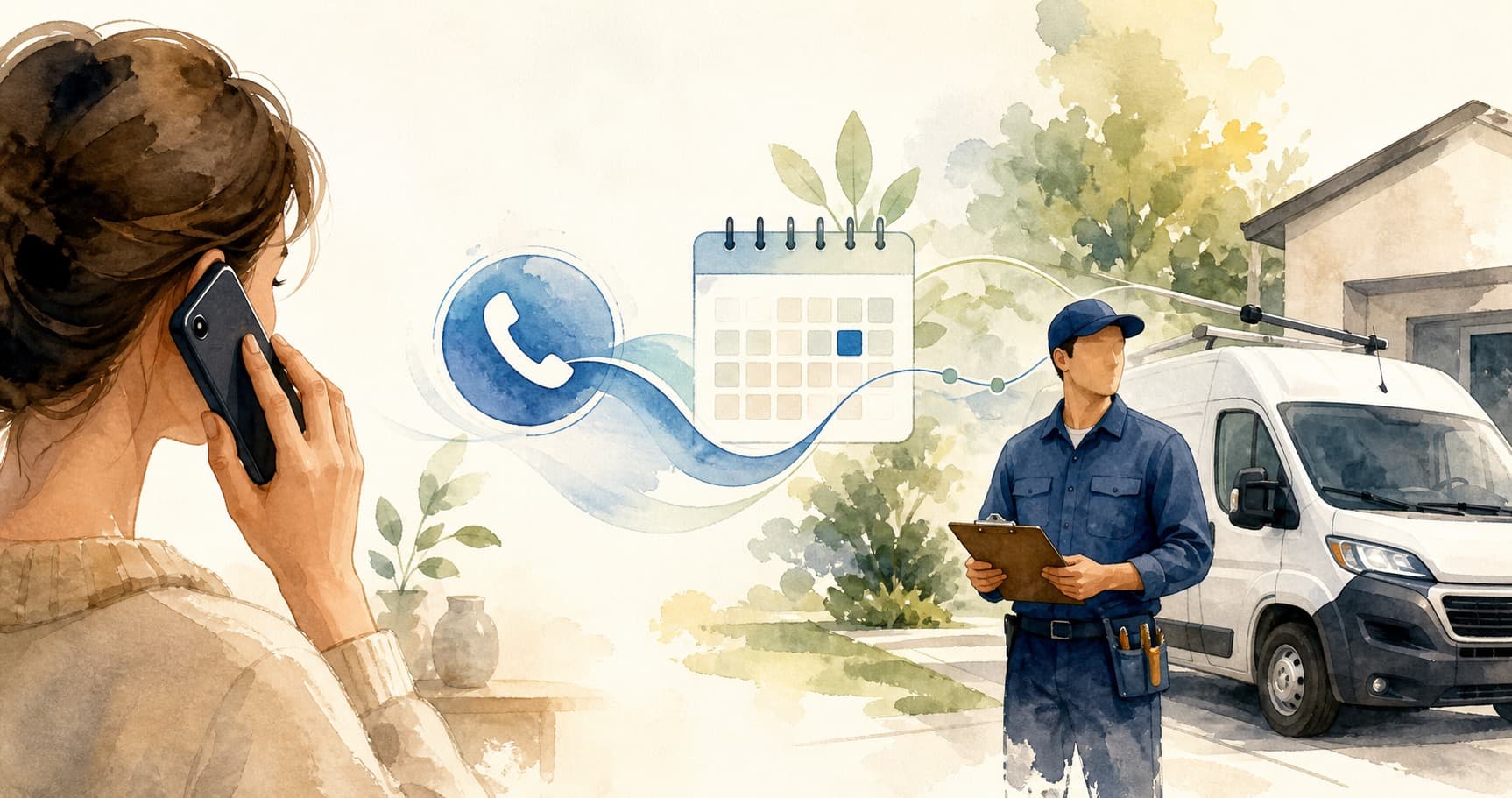
An AI receptionist for home service businesses is a call-and-follow-up workflow for home service businesses, not a generic voice bot. It answers the first question, identifies the reason for the call, captures the context staff would otherwise have to chase, and routes a defined next step. The useful outcome is faster booking and dispatch without leaving callers at voicemail.
This is a fit when the owner can point to calls missed while technicians are driving, working in homes, or serving another customer. It is not a replacement for dispatch judgment. It is a way to give every caller a fast first response and give the dispatcher the facts needed to choose the next move.
Start with the call pattern, not the software demo
Home-service calls mix new estimates, existing-customer problems, warranty questions, rescheduling, and occasionally urgent situations. A shared script that treats all of them as “book an appointment” creates bad leads and frustrated customers. Separate the high-value new-job path from existing-job support and from requests that need an on-call human.
Before comparing vendors, pull a representative sample of answered calls, voicemails, and missed calls. Label why each person called, what information the team needed, who owned the next action, and where a caller could be lost. That exercise gives the implementation a real specification rather than a list of attractive features.
What the workflow should collect before handoff
- Service needed, stated problem, and urgency
- Service address or ZIP code before promising coverage
- New lead, existing customer, warranty, or reschedule status
- Preferred appointment window, name, phone number, and approved contact method
Each completed intake should reach the CRM, team inbox, calendar, or dispatch queue with a timestamp and a clear owner. A phone number without a service need, location, urgency, and promised next step is not useful intake. If a caller does not qualify, the system should still leave a courteous, accurate record rather than inventing an answer.
Design the routing rules before taking calls live
- New estimate that fits the service area → booking or sales/dispatch queue
- Existing customer issue → customer record lookup or service queue
- Urgent or safety-sensitive wording → named on-call human under documented rules
- Missed transfer or after-hours routine inquiry → text acknowledgment plus assigned callback task
Routing is where an AI receptionist either becomes operationally useful or creates more work. The team should write the rules in plain language, name the on-call owner, set operating hours, and define what happens when nobody accepts the handoff. A missed transfer must fall back to a logged callback task or approved text follow-up; it cannot simply disappear into a transcript.
Three moments the workflow must handle well
A new estimate call while every technician is in the field
The agent should identify the trade, address, requested work, and timing, confirm the request is inside the service area, and offer only approved next steps. The win is not a magic quote. It is a complete request that a coordinator can act on without replaying voicemail.
An existing customer calling about an unfinished job
This caller should not be sent through a sales funnel. The workflow should recognize the existing relationship, capture the job reference or address and concern, then route to the service owner or a callback task with context.
A caller reaches voicemail after hours
If no live transfer is available, a fast approved text can acknowledge the call, set an honest expectation, and capture any missing details. The next-morning queue must have a named owner; automation without ownership is only faster voicemail.
What should never be automated without a human
- Safety-sensitive emergencies or instructions that belong to 911, utilities, or a licensed technician
- Exact pricing, repair promises, or arrival windows not approved by dispatch
- Technician assignment outside approved coverage, skills, or availability rules
Good coverage does not pretend every request is routine. It handles repeatable first response, says when a human must decide, and preserves the caller context. Do not give a call agent authority that the front desk, dispatcher, service advisor, or property manager does not actually have.
How to evaluate an AI receptionist for this operation
- Can it verify service area and avoid booking jobs the team will not serve?
- Can it distinguish an estimate from an existing-customer issue without forcing callers through a long script?
- Does the calendar or dispatch handoff include the information a coordinator needs?
- Can staff change hours, services, escalation contacts, and follow-up language without a rebuild?
Ask every vendor to demonstrate these conditions using your own examples, including an ambiguous caller and a caller who asks for a person. Then review the recording or transcript, the handoff message, the CRM note, and the resulting customer expectation. A pleasant voice is not the decision criterion; reliable execution through the whole workflow is.
A practical first 30 days
- Week 1: launch only after-hours and overflow calls for one service line
- Week 2: audit recordings, handoff notes, and every call that needed correction
- Week 3: add approved booking windows and missed-call text-back where the team can honor them
- Week 4: compare qualified requests and response time against the pre-launch baseline
Measure answered calls, qualified conversations, booked or routed next steps, missed-call recovery, response time, and unresolved handoffs. Review a small sample of completed calls each week with the people who own the work. That is how the prompt, routing, and follow-up rules become more accurate without turning the business into a testing lab.
Related decisions in this cluster
This page is the industry-specific buyer guide. It complements, rather than replaces, missed-call automation for contractors, AI dispatch intake and AI receptionist service. Use those pages to compare the adjacent workflow or choose the service layer that fits your operation.
Build an AI receptionist for home service businesses Workflow
AIEmployees designs practical call, SMS, booking, CRM, and human-handoff workflows around how your business actually operates.
Fill Out the Form →Related notes.

AI for Home Services: How Plumbers & Electricians Win More Jobs
AI answers every call, books appointments, and dispatches crews automatically.
Missed Call Automation for Contractors
How contractors use missed-call automation to text back instantly, qualify job leads, route urgency, book calls, and update CRM notes.
AI Dispatcher for HVAC and Plumbing Companies
Separate emergencies, collect job details, route technicians, recover missed calls, and protect service leads.